A Complete Guide to Kubernetes, DevSecOps, and SRE Integration

August 13, 2026 · 94 reads
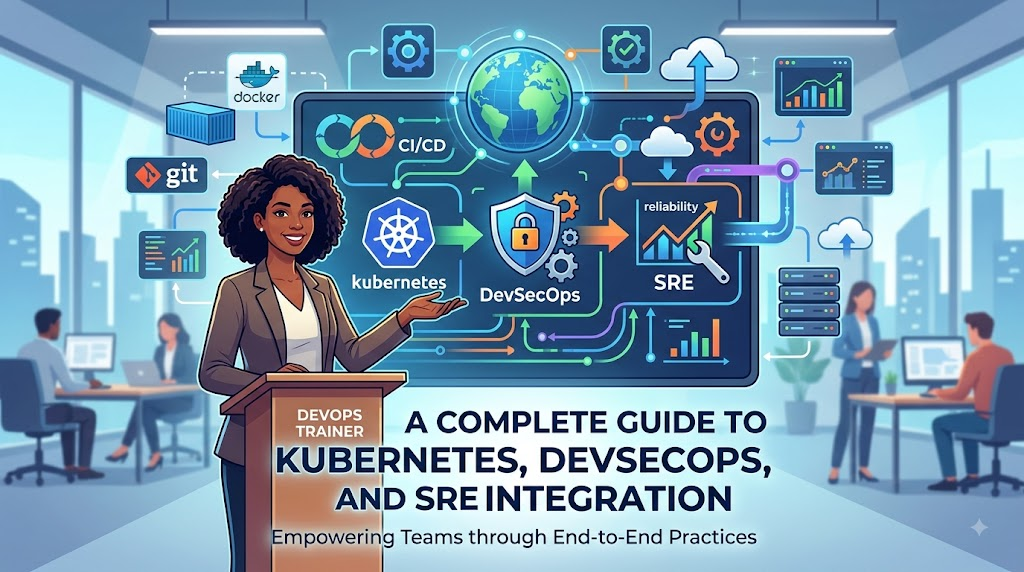
Modern software delivery depends on releasing features rapidly while maintaining top-tier security and system stability. To keep up with these operational demands, technology teams are transitioning away from monolithic hosting setups toward cloud-native ecosystems powered by container orchestration, automated release pipelines, shift-left security, and site reliability engineering (SRE).
Mastering these interconnected operational domains—from container management in Kubernetes to automated security testing (DevSecOps), reliability frameworks (SRE), and machine learning operations (MLOps)—requires a structured, practical skill-building approach.
This guide breaks down the core concepts of cloud-native infrastructure, details why these skills are critical for modern IT careers, outlines actionable learning pathways, and explores key industry trends shaping automated operations.
Understanding Cloud-Native Operations
Cloud-native operations center on building and running software applications specifically designed to leverage cloud automation and flexible resource allocation. Rather than migrating legacy applications onto basic virtual machines without architectural changes, modern approaches focus on microservices packaged in lightweight containers and managed dynamically.
At its core, this paradigm relies on Infrastructure as Code (IaC) and continuous deployment pipelines. By standardizing application environments, engineering teams ensure code behaves identically across local development setups, staging environments, and live production clusters.
Why Modern Infrastructure Skills Matter
Upgrading your operational toolkit transforms how engineering organizations build, test, and ship software, replacing manual troubleshooting with self-healing platform resilience.
- Elastic Resource Scaling: Microservice architectures adjust compute capacity dynamically based on real-time traffic volume, maintaining application performance while optimizing infrastructure expenses.
- Continuous Integration and Delivery: Automated pipelines allow development teams to roll out updates, patch vulnerabilities, and ship features regularly without causing service downtime.
- Shift-Left Security Automation: Running automated security checks early in deployment pipelines catches software vulnerabilities long before code reaches production environments.
- System Observability and Uptime: Real-time telemetry, centralized logging, and error-budget tracking help operational teams identify performance issues early and restore services automatically.
- Expanded Career Opportunities: As enterprises accelerate cloud transformation initiatives, engineering professionals skilled in modern deployment automation and platform management remain in high demand.
Core Technical Competencies to Focus On
To build a resilient career in cloud technology, technical professionals must master a combination of fundamental system administration skills and modern deployment tooling.
Systems Administration and Scripting
Fluency in Linux command-line operations, a solid understanding of network protocols (DNS, routing, subnets, TLS), and version control mastery using Git are essential prerequisites. Writing maintainable scripts in Python or Bash enables engineers to automate daily administrative tasks effectively.
Pipeline Orchestration and CI/CD Tools
Configuring continuous delivery systems requires direct experience with build automation engines. Mastering pipeline definitions, artifact repository management, automated unit test suites, and progressive deployment strategies (such as canary or blue-green releases) keeps software releases safe.
Cloud Platforms and Infrastructure as Code
Gaining direct experience across major public cloud providers like AWS and Azure provides crucial context for virtual networking, identity management, and cloud storage. Utilizing declarative tools like Terraform allows infrastructure to be versioned, shared, and provisioned programmatically.
Container Mechanics and Kubernetes Orchestration
Containers isolate application software from underlying hardware differences, while orchestrators manage scheduling, service discovery, and health monitoring. Essential focus areas include Dockerfile creation, container networking models, persistent storage configuration, and cluster administration in Kubernetes.
Observability, Metrics, and Security Integration
Maintaining platform defense requires embedding static code security tools and container vulnerability checkers directly into early build steps. Simultaneously, operational visibility relies on establishing centralized logging, distributed tracing, and real-time dashboard monitoring using tools like Prometheus and Grafana.
Practical Applications and Real-World Use Cases
Cloud-native principles solve complex technical operational challenges across various industry settings:
- Enterprise Modernization: Large financial or retail enterprises migrate legacy monolithic systems to cloud-native microservices running on Kubernetes, allowing independent teams to update microservices without risking core system stability.
- SaaS Scalability: Software-as-a-Service providers use automated CI/CD and autoscaling infrastructure to handle unpredictable usage spikes during peak business hours while maintaining consistent application performance.
- Automated Compliance Auditing: Organizations operating under strict regulatory frameworks embed automated compliance checks into pipelines, ensuring all deployed container images meet security standards prior to production release.
- Machine Learning Pipelines: Technical data teams adapt MLOps principles to automate data collection, model training, artifact registration, and API endpoint hosting alongside standard application software.
Common Learning Challenges
Acquiring expertise in cloud-native technologies comes with a unique set of challenges that learners and organizations often encounter:
- Tooling Overwhelm: Navigating the rapidly expanding landscape of open-source and proprietary tools makes it difficult for learners to decide which technologies to prioritize.
- Bridging Theory and Practice: Understanding abstract concepts through documentation does not always translate into knowing how to debug production incidents or design production-ready deployment pipelines.
- Kubernetes Learning Curve: Mastering cluster configurations, service meshes, persistent volumes, and custom resource definitions requires significant practice.
- Setting Up Complex Environments: Creating realistic, multi-node cloud environments for practice can be technically challenging and cost-prohibitive for self-directed learners without proper guidance.
How to Choose the Right Training Approach
Evaluating a structured learning program or professional guidance requires assessing several objective factors to ensure the education aligns with real-world requirements.
- Hands-On Lab Focus: Effective learning relies heavily on practical, scenario-based labs rather than passive lecture consumption.
- Up-to-Date Curriculum: Cloud technologies evolve rapidly; training materials must reflect modern industry standards, updated platform features, and current security practices.
- Real-World Project Portfolios: Programs should emphasize building end-to-end pipelines, provisioning real cloud infrastructure, and deploying multi-container applications.
- Troubleshooting and Debugging Practice: Quality programs teach how to diagnose, trace, and repair failing deployment pipelines, broken cluster configurations, and security policy violations.
Role of a Professional DevOps Trainer
Navigating complex cloud-native architectures often benefits from structured instruction led by experienced practitioners. A seasoned corporate trainer or specialized technical educator provides structured pathways that reduce time spent struggling with common setup pitfalls.
Whether seeking an online DevOps trainer for flexible skill development or engaging a dedicated corporate DevOps training solution for team-wide upskilling, qualified instructors bridge the gap between theoretical knowledge and enterprise implementation. Domain specialists—such as an AWS DevOps trainer, Azure DevOps trainer, or Kubernetes trainer—help learners master specific platform nuances.
Similarly, working with a DevSecOps trainer, SRE trainer, or MLOps trainer ensures that advanced concepts like pipeline security automation, error budgets, and model lifecycle management are taught using production-tested patterns. Structured guidance provided by an experienced DevOps Trainer ensures concepts are mastered efficiently through practical, real-world application.
Tailored Skill Paths by Learner Profile
Skill development goals should always adapt based on an engineer’s existing technical background and career objectives:
Beginners
Entry-level learners should focus on Linux command-line operations, basic networking, Git version control, and introductory container concepts before attempting complex cluster orchestration.
Working IT Professionals
System administrators, QA specialists, and developers can build upon existing domain knowledge by focusing on Infrastructure as Code, continuous integration pipelines, and multi-cloud administration.
Corporate Teams
Engineering departments benefit from standardized upskilling initiatives aligned directly with their internal tech stack, cloud vendors, and regulatory compliance standards.
Experienced Engineers
Senior developers and system architects require specialized coursework focused on custom Kubernetes extensions, zero-trust network policies, internal developer platform design, and enterprise observability.
Comparison of Common Learning Formats
Selecting the appropriate learning method depends on your preferred schedule, background, and career goals.
| Learning Approach | Target Audience | Key Advantage | Possible Challenge |
| Instructor-Led Training | Guided learners seeking direct interaction | Immediate feedback and structured accountability | Fixed class schedules |
| Self-Paced Digital Courses | Independent learners balancing tight schedules | Total scheduling flexibility | Requires high self-discipline |
| Corporate Workshops | Engineering teams and organizations | Tailored directly to company tech stacks | Requires organizational coordination |
| Practical Project Labs | Hands-on practitioners building portfolios | Direct validation of real-world technical skills | Requires lab environment access |
Best Practices for Mastering Cloud Technologies
Achieving proficiency in modern cloud systems requires a disciplined, practical learning methodology:
- Master Operating System Fundamentals: Focus on command-line interactions, shell scripting, and core networking principles before jumping into complex orchestration frameworks.
- Prioritize Practical Execution: Apply new concepts immediately by configuring actual cloud resources, writing pipeline scripts, and containerizing sample applications.
- Build Full-Stack Portfolio Assets: Construct complete portfolio projects that connect source repositories, automated build triggers, container registries, and live Kubernetes clusters equipped with telemetry monitoring.
- Practice Systematic Debugging: Dedicate time to reviewing build failure logs, inspecting network rules, and debugging container states to build strong diagnostic habits.
- Incorporate Security Scanning Early: Practice writing static code analysis steps and container vulnerability checks directly into local development pipelines.
Future Trends in Cloud Infrastructure
Staying competitive in technical engineering requires tracking the major technological shifts transforming infrastructure management:
- Internal Developer Platforms (IDPs): Organizations are adopting platform engineering to give developers self-service infrastructure capabilities while maintaining internal governance behind the scenes.
- AI-Assisted Operations (AIOps): Machine learning models are being integrated into observability stacks to streamline root-cause analysis, detect performance anomalies, and automate incident response.
- Standardized MLOps Workflows: As machine learning models become core software components, automating model training pipelines, tracking versions, and managing inference endpoints has become standard procedure.
- Deep Observability via eBPF: Operational teams are adopting advanced monitoring technologies like eBPF and distributed tracing to gain clear visibility into microservice interactions without modifying application source code.
Frequently Asked Questions
What does a professional DevOps trainer teach?
A trainer walks learners through the full software delivery lifecycle, including Linux system operations, version control, automated CI/CD pipelines, cloud provisioning, container management, Kubernetes cluster administration, pipeline security integration, and system observability.
What prerequisites should I learn before starting Kubernetes?
Before learning Kubernetes, you should have a firm understanding of basic Linux command-line operations, general networking concepts, containerization fundamentals using Docker, and basic application packaging concepts.
How does DevSecOps differ from traditional security practices?
Traditional security often operates as a final review step before software release. DevSecOps integrates automated security testing, static code analysis, and dependency vulnerability scanning continuously throughout every stage of the development pipeline.
Why is Site Reliability Engineering important for modern cloud platforms?
SRE applies software engineering principles to operational management, focusing on automated problem resolution, defining service level objectives (SLOs), and managing error budgets to maintain system availability while supporting rapid code releases.
What role does MLOps play in modern operations?
MLOps adapts continuous integration and continuous deployment concepts specifically for machine learning workflows. It automates model training, evaluation, versioning, deployment, and performance monitoring to ensure models remain accurate and reliable in production.
Is hands-on practical lab experience necessary for mastering cloud operations?
Yes. Conceptual understanding alone is insufficient for managing live production systems. Hands-on experience building, configuring, and troubleshooting actual pipeline setups and cloud clusters is essential for developing real-world technical competency.
Navigating modern cloud operations requires a deliberate balance of foundational IT knowledge, hands-on tool mastery, and a firm grasp of continuous improvement methodologies. By focusing on practical projects, mastering continuous integration pipelines, understanding container orchestration with Kubernetes, and embedding security and reliability directly into your development lifecycles, you build the real-world capabilities needed to support modern engineering operations.
Leave a Reply