AI News Aggregator: A Smarter Approach to Modern News Discovery

October 28, 2026 · 20 reads
Introduction: Why Finding Reliable News Is Becoming More Difficult
Every day, thousands of news stories emerge across digital publications, television networks, independent journalism platforms, industry publications, and regional media outlets. Important developments can unfold across several countries simultaneously, making it difficult for readers to identify which stories deserve their attention. Even people who follow the news regularly may struggle to separate meaningful developments from repeated headlines, incomplete reports, and unnecessary updates.
The challenge is no longer simply finding information. It is finding relevant information, understanding its context, and determining whether it comes from a trustworthy source.
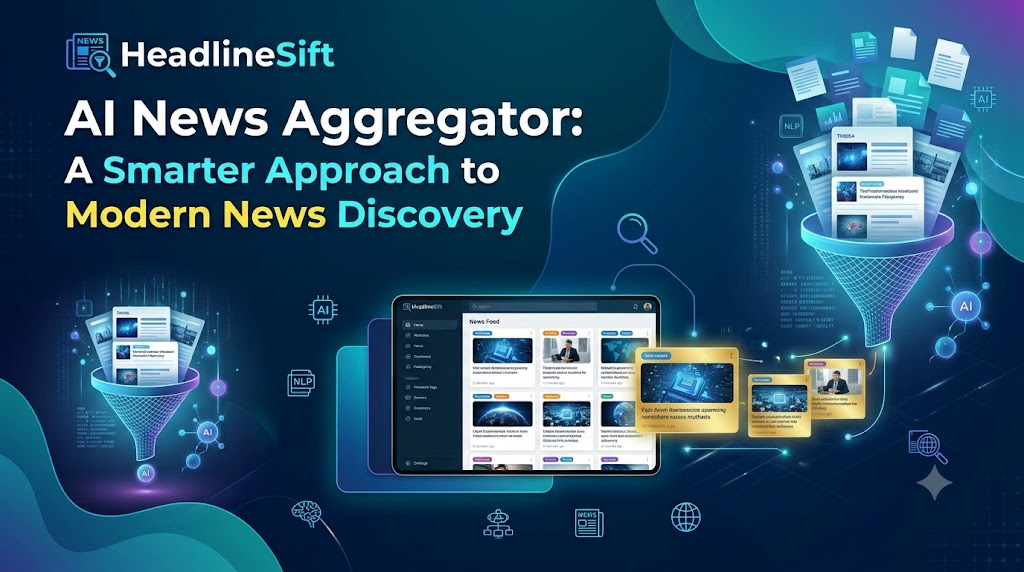
An AI News Aggregator offers a practical approach to this challenge by using artificial intelligence to collect, organize, classify, and present news from multiple available sources. Instead of requiring readers to visit numerous publications individually, an aggregation system can bring related coverage together and help users explore developments more efficiently.
Platforms such as HeadlineSift represent the broader category of services associated with modern news discovery, where the goal is to make information easier to navigate. The value of this approach lies not in replacing journalism but in helping readers find and understand reporting that might otherwise be overlooked.
However, effective news discovery requires more than automation. Source quality, accurate summaries, diverse perspectives, and human judgment remain essential. Understanding how these systems work can help readers use them more responsibly and get greater value from their daily news routine.
From Traditional News Feeds to Intelligent News Discovery
Traditional news feeds generally organize articles according to publication time, selected categories, or editorial preferences. They are useful for discovering new stories, but they may offer limited assistance when multiple publications cover the same event or when readers want to follow a developing topic across different sources.
An AI-powered aggregation system introduces additional layers of organization.
What Is an AI News Aggregator?
An AI News Aggregator is a digital system that gathers news content from available sources and uses automated techniques to organize it into meaningful groups. Depending on its design, it may identify related stories, recognize subjects, generate summaries, rank relevant articles, and recommend content based on reader preferences.
For example, a reader interested in artificial intelligence might encounter reports about a new AI model, changes in technology regulations, enterprise adoption, and concerns about data security. Rather than treating every article as an unrelated item, an intelligent system may group them into relevant subjects.
This organization helps readers move from isolated headlines toward a clearer understanding of a broader topic.
How It Differs From a Traditional News Feed
A conventional feed might display twenty articles in chronological order, including several reports about the same announcement. An AI-enhanced feed may identify the overlap, group related reports, and help readers distinguish the central development from additional commentary.
The main differences can include:
- Automated collection: Bringing together available content from multiple publications.
- Topic classification: Assigning articles to subjects such as business, technology, politics, science, or finance.
- Related-story grouping: Identifying reports that discuss the same event or connected developments.
- Relevance detection: Estimating which stories are most closely related to a user’s interests.
- Personalized discovery: Presenting content according to selected subjects, industries, locations, or reading preferences.
These capabilities depend on the system’s data sources, algorithms, and available features. AI does not automatically make a news feed more accurate or comprehensive. Its effectiveness depends on how well the underlying processes are designed and evaluated.
What Happens Behind an AI-Powered News Feed?
AI news aggregation generally follows a sequence of information-processing steps. The precise implementation differs between platforms, but the overall workflow helps explain how scattered reports can become an organized news experience.
1. Collecting Available News Content
The process begins with gathering articles, headlines, publication details, and other permitted information from supported sources. Depending on the system, this information may be obtained through feeds, APIs, licensed content, or other authorized collection methods.
The range of available sources matters. A system that relies on a narrow selection of publications may overlook regional developments or alternative perspectives, even if its technology performs well.
2. Processing Headlines and Article Text
After collection, the system processes available text to identify important terms, subjects, names, locations, organizations, and events.
Natural language processing helps computers interpret relationships between words and phrases. For example, reports containing different descriptions of an electric vehicle manufacturer’s expansion may still refer to the same business development.
This stage helps the system understand what an article discusses rather than relying exclusively on individual keywords.
3. Classifying Topics and Grouping Related Stories
The system can assign articles to categories and compare their content to identify similarities. Related-story grouping can reduce repetition while preserving access to individual reports.
Consider a technology company announcing a new artificial intelligence model. One publication may emphasize its technical capabilities, another may examine its commercial applications, and a third may discuss privacy concerns.
Although all three articles cover the same announcement, they contribute different information. A useful aggregator groups them under the main event without treating their perspectives as interchangeable.
4. Generating Summaries and Presenting Updates
Some systems use AI to create short summaries of longer reports. These summaries can highlight the central announcement, relevant background, and major developments.
The resulting feed may present a headline, a concise overview, related coverage, and information about the original publication.
A critical distinction is that summarization does not guarantee verification. An AI system may accurately shorten a misleading article without correcting its underlying errors. Readers should therefore treat summaries as navigation aids rather than substitutes for careful reporting.
The Features That Help Readers Understand More in Less Time
The usefulness of a news aggregation platform depends on how effectively its features address real information needs.
AI News Summarizer Tools
An AI News Summarizer condenses longer articles into shorter explanations. It can help readers quickly identify the main event, important details, and questions that deserve further investigation.
For example, a lengthy report about new cybersecurity regulations might contain legal background, technical requirements, industry responses, and implementation dates. A concise summary can help a reader understand the main changes before deciding whether to read the full report.
However, summaries may omit qualifications, minority viewpoints, or important distinctions between confirmed facts and preliminary statements. Readers making business, financial, or professional decisions should examine the original reporting and relevant documentation.
Curated News Headlines
Curated News Headlines help organize a large volume of articles into a more manageable selection. Curation can be based on subject relevance, editorial judgment, reader preferences, publication time, or automated ranking.
Good curation does not simply select the most dramatic stories. It also helps readers recognize important developments that may receive less attention, including regulatory changes, scientific findings, and regional issues.
The quality of a curated feed depends on the selection criteria and the diversity of the content being considered.
Duplicate-Story Detection
Duplicate detection identifies reports that substantially overlap. This can prevent a single announcement from occupying a large portion of a news feed simply because several outlets have covered it.
Nevertheless, duplicate detection should distinguish between repeated information and genuinely different reporting. Two articles may discuss the same event while offering different evidence, expert perspectives, or consequences.
A strong system reduces unnecessary repetition without hiding meaningful differences.
Topic-Based Discovery and Breaking News Alerts
Topic-based discovery helps readers follow specific subjects over time, such as AI regulation, renewable energy, software security, or international trade.
A Breaking News Aggregator can also help users identify rapidly developing events across available publications. Alerts may be useful when an announcement affects public safety, an industry, or an important business decision.
The risk is that early reports can be incomplete or contradictory. An alert should communicate what is known without presenting uncertain details as established facts. Readers should also have control over notification frequency to avoid information overload.
Personalized Feeds
Personalized feeds prioritize content related to a reader’s selected interests. This can make daily news consumption more efficient, particularly for people who follow several professional subjects.
Personalization is most useful when it improves relevance while preserving opportunities to discover unfamiliar but important developments.
One News Platform, Different Information Needs
News aggregation can support different audiences because each group looks for different types of information. The underlying technology may be similar, but the most useful categories, ranking criteria, and summaries vary according to the reader’s goals.
Technology Professionals
A Technology News Aggregator can help software developers, IT managers, cybersecurity specialists, and technology researchers follow developments across multiple technical fields.
A software engineer might monitor programming tools, cloud infrastructure, AI systems, and security vulnerabilities. An IT manager may be more interested in vendor announcements, product lifecycle changes, compliance requirements, and enterprise technology spending.
Grouping related coverage helps these readers identify connections between technical developments and practical decisions. However, critical technical claims should be checked against product documentation, security advisories, research papers, or other authoritative material.
Business Readers
A Business News Aggregator can bring together corporate announcements, industry changes, competition, leadership decisions, supply chain developments, and emerging market opportunities.
Suppose several manufacturers announce investments in automated production. Looking at these announcements together may help a business reader identify a wider industry trend. Additional reporting may reveal whether the investments reflect labor shortages, productivity goals, changing demand, or regulatory pressures.
The aggregator can surface the pattern, but determining its business implications requires further investigation.
Financial Readers
Financial News Headlines can help investors, analysts, and business professionals monitor earnings announcements, interest rate decisions, economic indicators, mergers, and changes in corporate performance.
Grouping reports around a company or economic event can reduce the time required to find relevant coverage. It may also help readers compare market commentary with company statements and official economic releases.
Financial decisions require particular caution. A headline or AI-generated summary cannot establish whether an investment is suitable, and automated interpretations should not be treated as guarantees of market behavior.
International Readers
A Global News Aggregator can help readers follow events across countries and regions without relying exclusively on the media coverage available in their immediate location.
For example, a change in international trade policy may affect manufacturers, logistics companies, consumers, and financial markets in different ways. Combining coverage from relevant regions can help readers understand the broader picture.
Language differences, local terminology, publication timing, and regional reporting priorities can still create gaps. Readers should consider the location and perspective of each source when interpreting international developments.
General Readers
General readers often want to know what matters without checking multiple news applications throughout the day. A Breaking News Aggregator can help them identify major developments and explore related coverage when necessary.
A balanced feed should include a reasonable mix of public affairs, science, health, business, technology, culture, and local developments according to the reader’s interests.
The objective is not to consume every available headline. It is to remain informed about important events without allowing news consumption to dominate the day.
Turning Headlines into Context: The Value of News Impact Analysis
A headline explains what a publication considers important about an event. Context helps readers understand why the event matters, how it relates to previous developments, and what questions remain unanswered.
News Impact Analysis uses information about events, related reports, industry conditions, and historical developments to explore possible implications. AI can assist by organizing evidence and identifying recurring themes, but the quality of the analysis depends on the information available and the reasoning applied.
Recognizing Patterns Across Multiple Reports
Imagine that several publications report increased investment in data centers, new demand for computing infrastructure, and concerns about electricity consumption. An aggregation system may group these stories and help readers recognize a common theme: the growing resource requirements associated with digital services.
The next step is to investigate what the pattern means. Readers might examine infrastructure costs, electricity availability, environmental considerations, and regional investment decisions.
The aggregator makes the information easier to explore, but additional evidence is necessary before drawing conclusions.
Distinguishing Correlation From Causation
One of the most important responsibilities in news analysis is avoiding unsupported causal claims.
If two developments occur at approximately the same time, that does not prove that one caused the other. A change in company performance might coincide with a new regulation, but other factors such as demand, pricing, competition, or operational changes may also contribute.
AI-generated analysis can suggest possible connections worth investigating. It should not transform those suggestions into established facts without adequate evidence.
Following Developing Events
Grouping updates over time can help readers understand how a story evolves. An initial announcement may be followed by official clarification, independent analysis, public responses, and corrections.
A useful system should make it easier to distinguish the original event from subsequent interpretations. It should also preserve publication dates and indicate when earlier reports have been updated.
For high-impact decisions, readers should compare independent reporting and consult expert judgment rather than relying on an automated interpretation alone.
Personalization Without Missing the Bigger Picture
A Personalized News Digest organizes information according to selected interests, industries, locations, and preferred topics. Instead of starting each day with a large, unfiltered list, readers can review a more focused selection.
For example, someone working in manufacturing might prioritize industrial automation, supply chain policy, energy costs, and technology investment. A university student may prefer education policy, scientific discoveries, employment trends, and international developments.
Personalization becomes especially useful when users can adjust their interests and change the balance between familiar subjects and broader news.
The Risk of Filter Bubbles
A filter bubble can develop when a reader repeatedly receives information that reinforces existing interests or viewpoints. Even without deliberate bias, recommendation systems may favor familiar subjects because they are more likely to attract attention.
This can leave readers unaware of important counterarguments, emerging issues, or developments outside their usual interests.
A practical solution is to reserve part of a news feed for broader coverage. Readers can also compare publications with different editorial perspectives and periodically review their selected topics.
Managing Notifications and Privacy
Frequent notifications can create the impression that every update demands immediate attention. Readers benefit from choosing which topics deserve alerts and which can wait for a scheduled review.
Privacy is another consideration. Some personalization systems may use reading activity, saved preferences, or other behavioral information. Users should understand what information is collected, how it is used, and which controls are available.
Personalization should make news easier to manage, not create unnecessary pressure or obscure how recommendations are produced.
When AI News Aggregation Gets Things Wrong
AI news aggregation can improve organization and discovery, but it introduces risks that readers should understand.
Misleading Headlines and Incomplete Summaries
Headlines often compress complex events into a few words. This can remove important qualifications or make a preliminary finding appear more conclusive than it is.
AI summaries may introduce a similar problem when they omit context, misunderstand technical language, or combine details that belong to different parts of a report.
Readers should examine the original article when a claim appears surprising, consequential, or difficult to interpret.
Duplicate Reports and Outdated Information
Several articles may repeat the same original claim without independently verifying it. A large number of matching headlines does not necessarily represent a large amount of independent evidence.
Developing stories also change. Early estimates may be revised, official statements may correct earlier information, and initial explanations may prove incomplete.
Checking timestamps, update notices, and the original source can help readers identify stale or superseded reporting.
Algorithmic Bias and Source Limitations
AI systems reflect the data and design choices behind them. If a system consistently favors certain publishers, languages, regions, or subject categories, its output may provide an incomplete view of events.
Source diversity is therefore essential. A broad range of publications can improve discovery, although diversity alone does not guarantee accuracy.
Readers should distinguish between independent reporting, commentary, syndicated material, and repeated claims originating from a single source.
A Practical Verification Process
Before relying on an important news item, readers can ask a few simple questions:
- Who originally reported the information?
- Does the article distinguish confirmed facts from allegations, estimates, or predictions?
- Are independent, credible publications reporting the same central facts?
- Has an official document, direct statement, or primary source been made available?
- Is the report current, and have significant corrections or updates appeared?
- Does the summary accurately represent the full article?
These checks are particularly important for public safety, financial decisions, legal matters, health information, and rapidly developing events.
Choosing a News Aggregation Approach That Fits Your Needs
The best news aggregation approach is not necessarily the one that displays the largest number of stories. It is the one that helps readers find useful information, understand its limitations, and investigate important developments efficiently.
Consider the following factors when evaluating a platform.
Source diversity: Check whether the service covers different publications, regions, and subject areas. A narrow source selection can produce a distorted picture of events.
Transparency: Look for clear information about how articles are selected, grouped, ranked, and summarized. Readers should be able to understand why a story appears in their feed.
Summary accuracy: Assess whether summaries preserve important qualifications and distinguish confirmed information from speculation. Access to the complete article is valuable.
Update frequency: Consider whether the platform updates often enough for your needs and makes publication times visible. Faster updates are not automatically better if they increase the circulation of unverified information.
Category coverage: Choose a service that supports the subjects you actually follow, whether that means technology, business, finance, international affairs, or general news.
Personalization controls: Check whether you can adjust topics, reduce repetitive recommendations, manage notifications, and discover subjects outside your usual interests.
Privacy: Review the service’s approach to reading history, personal preferences, data retention, and user control.
Usability: Evaluate whether the feed makes important information easier to find without creating unnecessary clutter. Clear categories and effective search can be more valuable than a large number of features.
Access to original reporting: Ensure that you can investigate the full article and identify the publication responsible for the reporting.
These factors help readers assess the practical value of a service independently of its marketing claims. The objective should be better information access, not simply higher headline volume.
What the Next Generation of News Discovery Could Look Like
AI-powered news discovery continues to develop, and several capabilities may become more useful as language processing and information retrieval improve.
Multilingual Summaries
Improved multilingual systems could help readers understand reporting published in languages they do not speak. This may broaden access to regional journalism and international perspectives.
However, translation systems must handle cultural references, legal terminology, and local context carefully. A fluent translation can still misrepresent a nuanced statement.
Better Event Tracking
Future systems may become more effective at connecting announcements, follow-up reports, official responses, and later developments into a coherent timeline.
This could make it easier to understand how a story changes over time, particularly when different publications report separate parts of the same event.
Reliable event tracking will require careful handling of corrections, conflicting accounts, and uncertain information.
Conversational News Search
Conversational search could allow readers to ask questions such as why a policy matters to a particular industry or how a new announcement relates to an earlier development.
Such tools may reduce the effort required to navigate large amounts of reporting. Their answers should still identify the underlying evidence and make it possible to inspect original coverage.
More Contextual Recommendations and Trend Analysis
Recommendation systems may improve their ability to distinguish a reader’s immediate interests from longer-term information needs. Trend analysis may also help readers explore connections between developments across industries and regions.
These capabilities should be treated as decision-support tools rather than independent authorities. Journalism, editorial oversight, original research, and expert analysis will remain important for establishing facts and explaining complex events.
The most useful future systems will combine automation with transparency, reliable sourcing, and meaningful user control.
Conclusion: Using AI to Become a Better-Informed Reader
AI news aggregation offers a practical way to manage the growing volume of digital information. By organizing related stories, identifying topics, producing concise summaries, and supporting personalized discovery, an AI News Aggregator can reduce the effort required to find relevant reporting. Its greatest value, however, is not simply speed. It is the opportunity to move from a collection of disconnected headlines toward a clearer understanding of events, competing perspectives, and unanswered questions.
HeadlineSift can be understood within this broader discussion of modern news discovery, where making information easier to navigate is an important part of the reader’s experience. The wider challenge for every aggregation approach is to balance convenience with source diversity, accuracy, transparency, and context. Readers should continue to verify important claims, compare independent reporting, examine original sources, and remain open to perspectives outside their usual interests. AI can help organize the information, but it cannot remove the need for critical thinking. Ultimately, becoming better informed requires more than seeing more headlines. It requires asking better questions, understanding the evidence, and recognizing the difference between a report, an interpretation, and a proven fact. When used thoughtfully, AI-powered news discovery can support that process and help people make more informed decisions in an increasingly complex information environment.
Leave a Reply